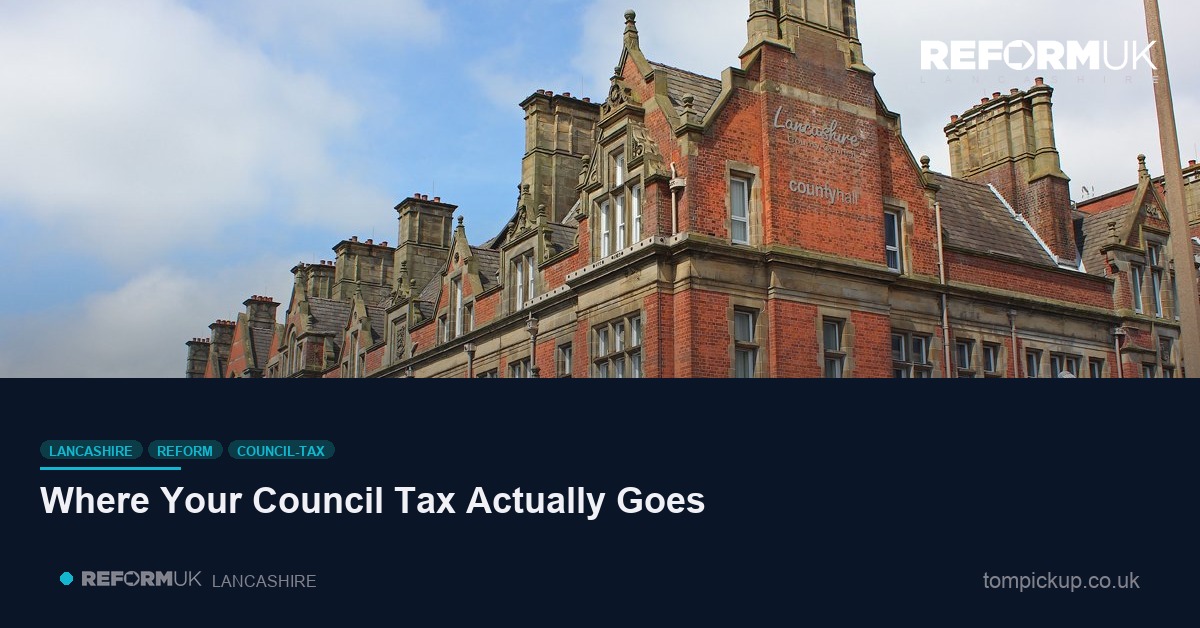
Watch: video summary with voiceover
Your council tax bill is not set by one authority. It is set by four. Each one decides its own share, within its own cap, for its own services. Understanding who charges what is the first step to understanding who is responsible for what.
Who Sets Your Council Tax?
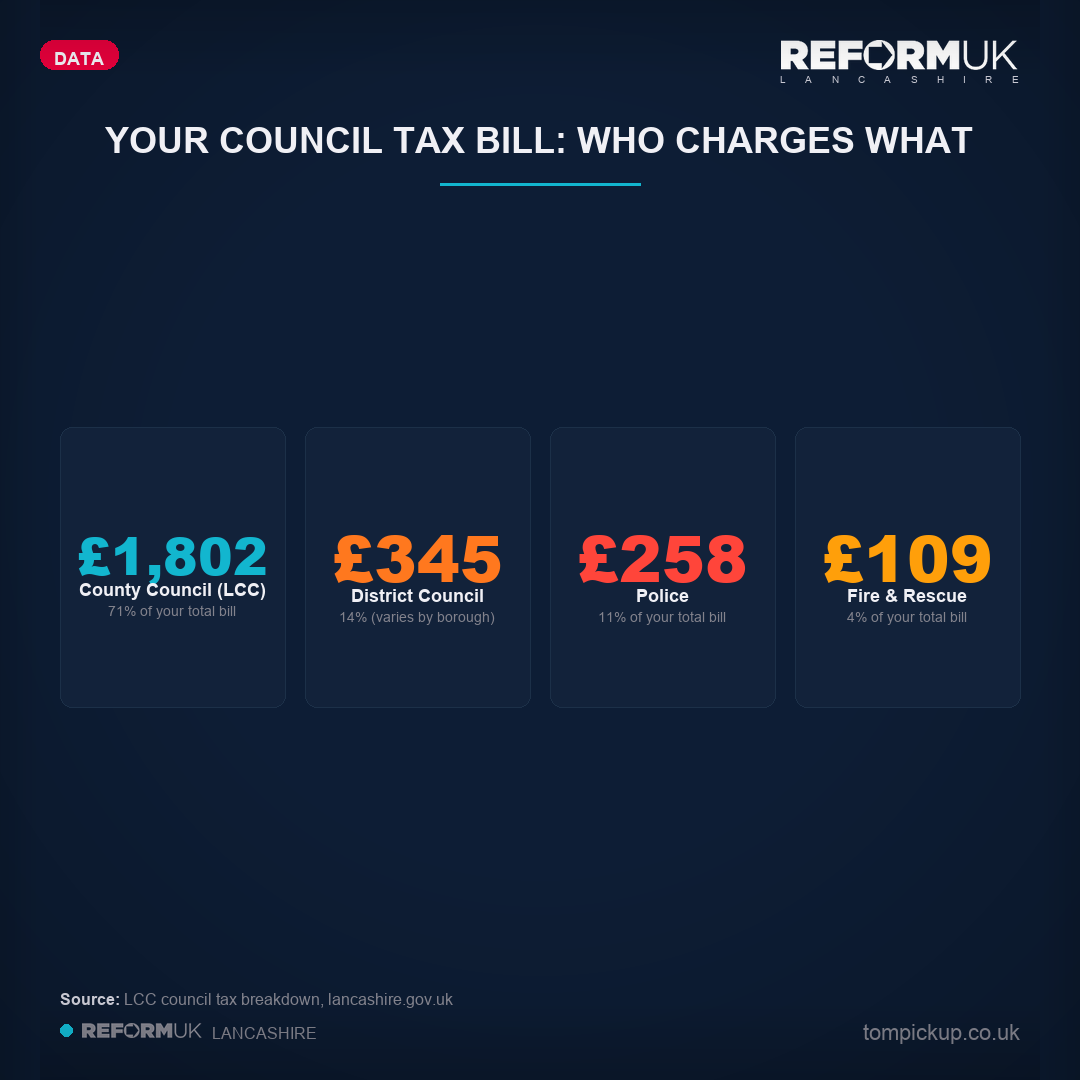
Four authorities set your total Band D bill. Each one has its own cap, its own budget, and its own political decisions. Using Burnley as an example for 2025/26:
| Authority | Band D Share | % of Total | Services |
|---|---|---|---|
| Lancashire County Council | £1,735.79 | 71% | Highways, schools, social care, waste disposal, libraries, fire |
| Burnley Borough Council | £344.58 | 14% | Housing, planning, waste collection, leisure, parks |
| Lancashire Police | ~£258.38 | 11% | Policing and crime prevention |
| Lancashire Fire & Rescue | ~£108.75 | 4% | Fire and rescue services |
| Parish precepts | ~£8.33 | <1% | Parish and town council services |
| Total | £2,455.83 | 100% |
Source: LCC council tax breakdown, lancashire.gov.uk. Police and fire shares are approximate based on precepting authority returns.
The county council share is by far the largest. That is where Reform has direct control. That is where we made the political choice.
The 3.80% Breakdown: A Deliberate Choice
Council tax rises for upper-tier authorities like LCC have two components, each with its own cap set by the government:
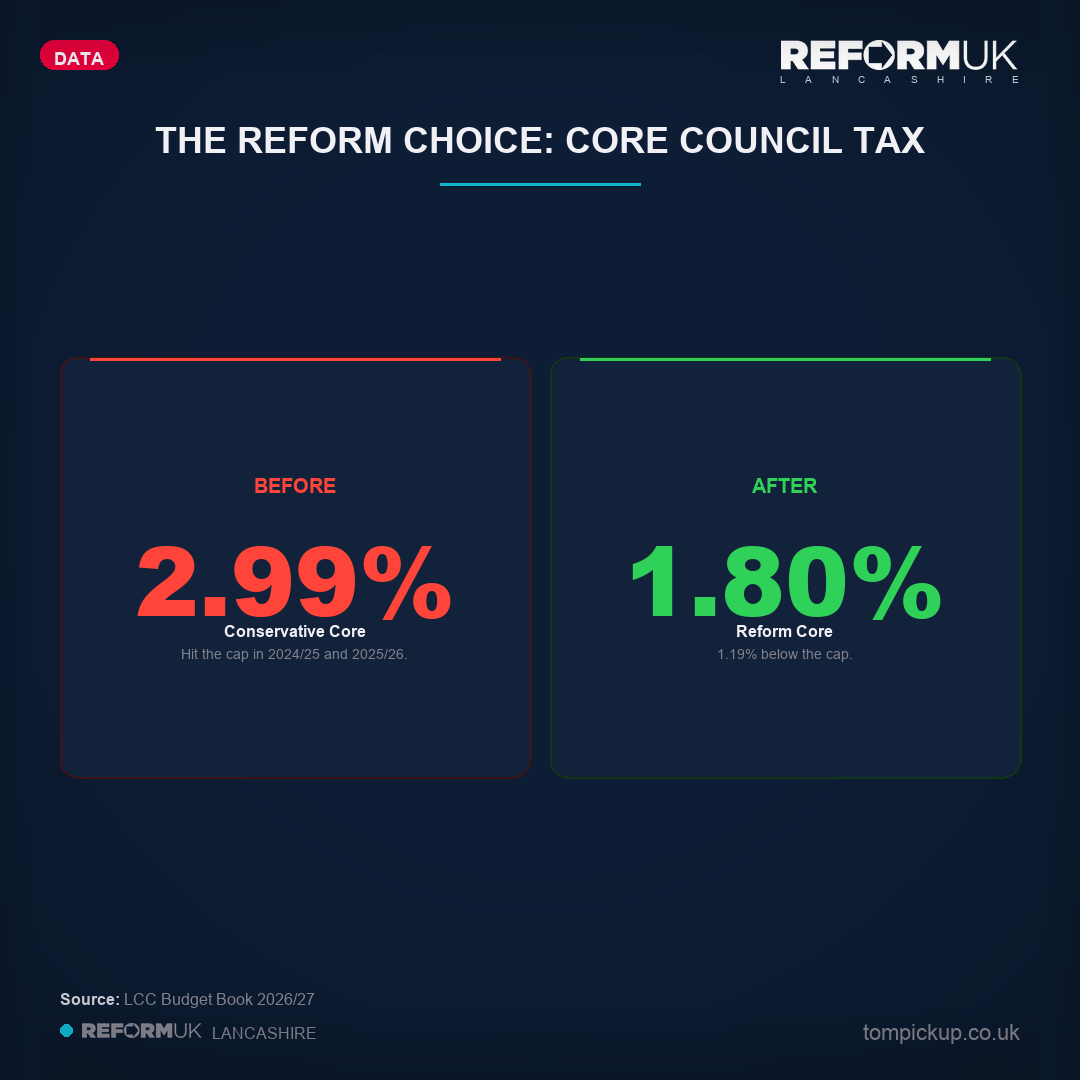
The core 1.80% is the political choice. The government allows up to 2.99% without a referendum. Reform chose to set it at 1.80%, leaving 1.19% on the table.
The 2.00% ASC precept is driven by demand. Adult social care consumes over 40% of the county council budget. Lancashire has an aging population. Care costs are rising 3 to 5% per year nationally. Every council in England with social care responsibilities uses the full ASC precept because the demand requires it. This is not optional spending. It is the cost of looking after elderly and vulnerable residents.
The difference between Reform and the Conservatives is clear:
The Conservatives used the full ASC precept AND hit the core cap too. Their total was 4.99% in each of the last two years: 2.99% core plus 2.00% ASC. Reform total: 3.80%. Same ASC precept, but 1.19% lower on the part where the political choice sits.
A Decade of Council Tax Rises
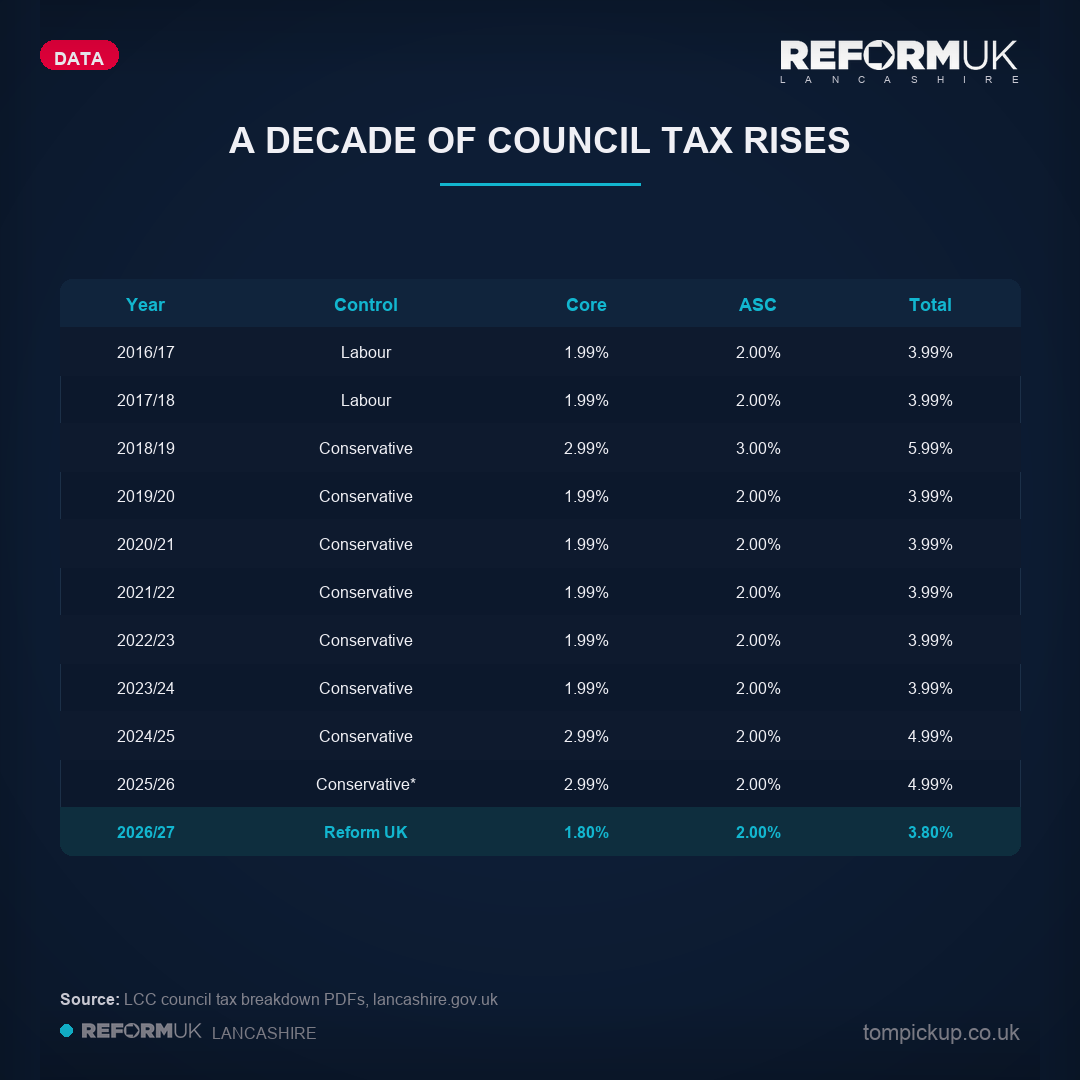
For ten consecutive years, council tax rose every single year, under Labour and then Conservative administrations. The table below shows the core rate and ASC precept for each year.
| Year | Control | Core | ASC | Total |
|---|---|---|---|---|
| 2016/17 | Labour | 1.99% | 2.00% | 3.99% |
| 2017/18 | Labour | 1.99% | 2.00% | 3.99% |
| 2018/19 | Conservative | 2.99% | 3.00% | 5.99% |
| 2019/20 | Conservative | 1.99% | 2.00% | 3.99% |
| 2020/21 | Conservative | 1.99% | 2.00% | 3.99% |
| 2021/22 | Conservative | 1.99% | 2.00% | 3.99% |
| 2022/23 | Conservative | 1.99% | 2.00% | 3.99% |
| 2023/24 | Conservative | 1.99% | 2.00% | 3.99% |
| 2024/25 | Conservative | 2.99% | 2.00% | 4.99% |
| 2025/26 | Conservative* | 2.99% | 2.00% | 4.99% |
| 2026/27 | Reform UK | 1.80% | 2.00% | 3.80% |
2016/17 and 2017/18 budgets were set by the Labour minority administration under Jenny Mein. 2025/26 budget was set by the outgoing Conservative administration before the May 2025 election.
Source: LCC council tax breakdown PDFs, lancashire.gov.uk.
Over those ten budgets, the LCC Band D element rose from £1,174.86 to £1,735.79. That is an extra £560.93 per household, a 47.7% increase. Reform added £65.96 in its first budget. Still a rise. But the lowest in 12 years.
What £1,801.75 Buys You
The LCC Band D element for 2026/27 is £1,801.75. Here is where it goes:
Adult social care alone costs more than highways, waste, and public health combined. That is why the ASC precept exists. That is why every county and unitary council in England uses the full ASC precept. The demand is not political. It is demographic.
The £21 Difference
The Conservatives set the 2025/26 rise at 4.99%. Reform set 2026/27 at 3.80%. That 1.19% difference on the core rate means:
Twenty-one pounds per household is not transformative. We are not pretending it is. But it represents a principle: the council should not automatically take the maximum every year. The Conservatives treated the cap as a target. Reform treats it as a ceiling.
What Comes Next
This article is the second in a series breaking down Reform’s first year at Lancashire County Council. The next will examine the bond scandal: how £600 million in bonds was acquired without proper disclosure, and what Reform scrutiny uncovered.
We are not celebrating a council tax rise. We are explaining where your money goes, who sets each part of the bill, and why Reform chose to charge less. The direction has changed. We are just getting started.
Every figure in this article is sourced from official records.
LCC Budget Book 2026/27, LCC council tax breakdown PDFs, and GOV.UK referendum principles reports. All publicly available at lancashire.gov.uk