Watch: 2-minute video summary with voiceover
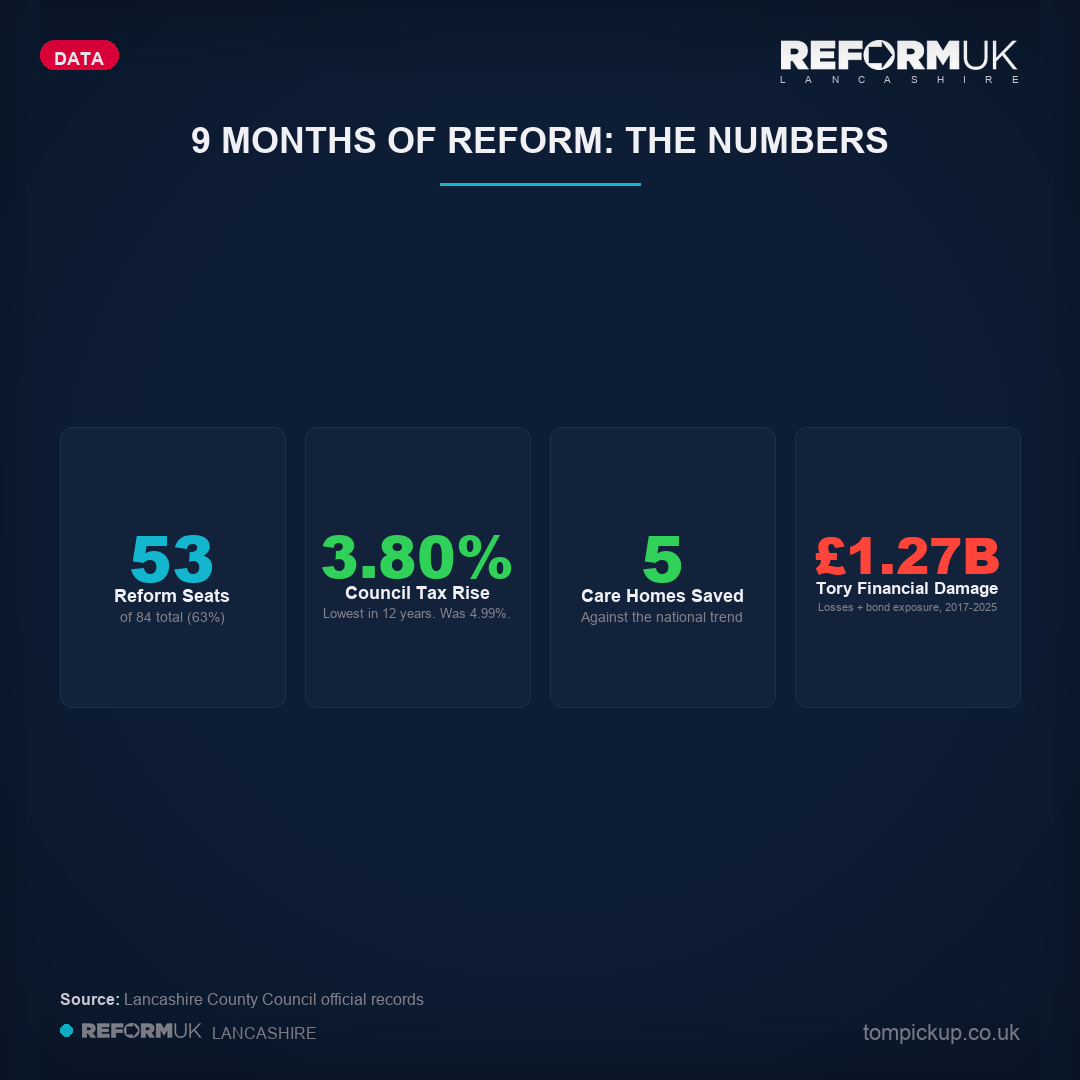
On 1 May 2025, Reform UK won 53 of 84 seats at Lancashire County Council, the first time any party outside the Conservatives or Labour had controlled a county council in England. Nine months later, the results are in the accounts, in the roads, and in the services that residents actually use.
This is not a political sales pitch. It is a comparison: what we inherited versus what we have done, measured in the same units the council has always used.
The Budget: Stopping the Rot
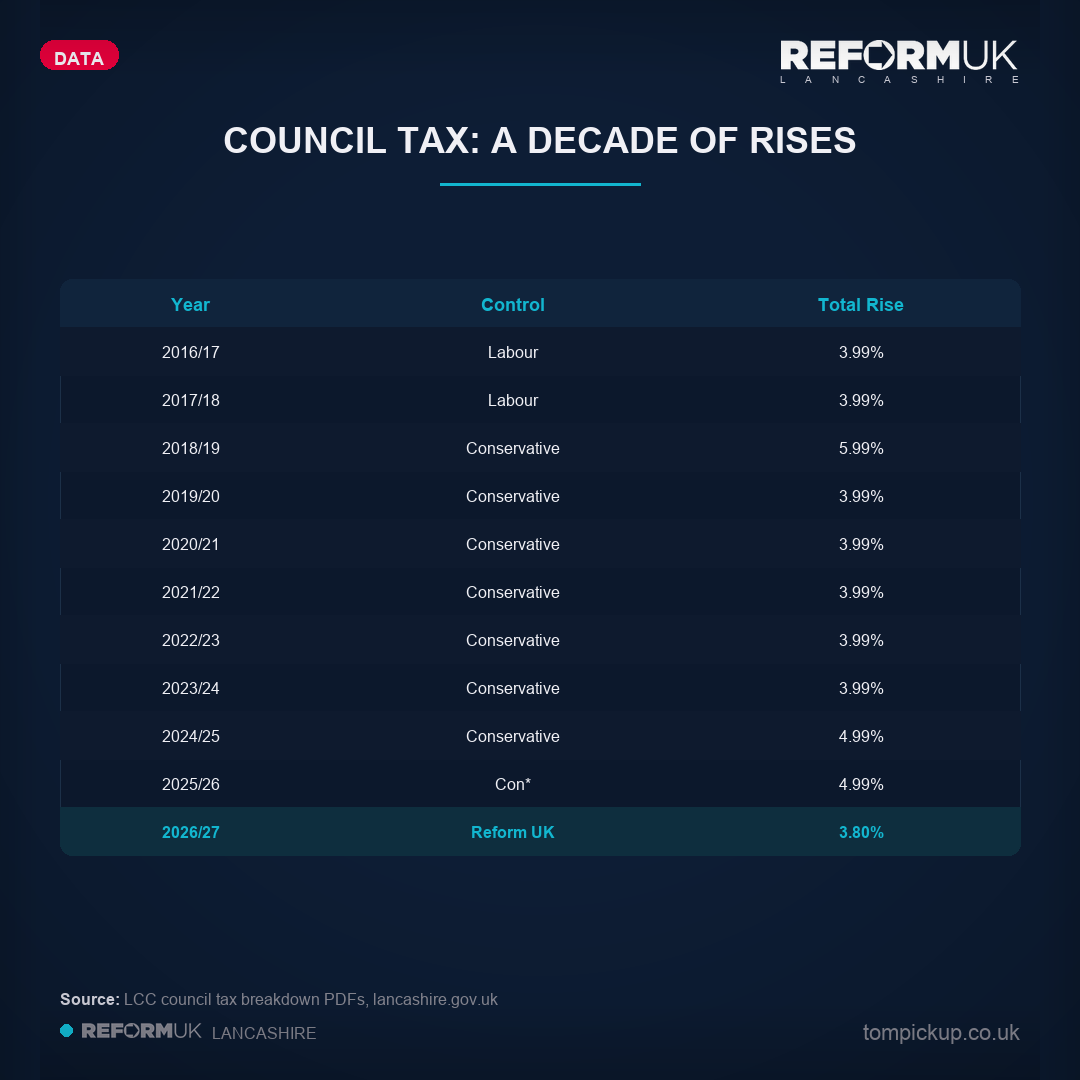
For ten consecutive years, council tax rose every single year, under Labour and then Conservative administrations. In the last two years under the Conservatives, it hit 4.99%, the highest rises in the entire decade.
Reform’s first budget, passed in February 2026, set the rise at 3.80%. The lowest in 12 years.
- 1.80% for general council services (cap: 2.99%)
- 2.00% for the Adult Social Care precept (cap: 2.00%)
We are not celebrating a rise. We are stopping the rot. Band D residents now pay £1,801.75 for the county share. Still too high. But the lowest rise in 12 years. The direction has changed.
| Year | Control | Total Rise |
|---|---|---|
| 2016/17 | Labour | 3.99% |
| 2017/18 | Labour | 3.99% |
| 2018/19 | Conservative | 5.99% |
| 2019/20 | Conservative | 3.99% |
| 2020/21 | Conservative | 3.99% |
| 2021/22 | Conservative | 3.99% |
| 2022/23 | Conservative | 3.99% |
| 2023/24 | Conservative | 3.99% |
| 2024/25 | Conservative | 4.99% |
| 2025/26 | Conservative* | 4.99% |
| 2026/27 | Reform UK | 3.80% |
2016/17 and 2017/18 budgets were set by the Labour minority administration. 2025/26 budget was set by the outgoing Conservative administration before the May 2025 election. Source: LCC council tax breakdown PDFs, lancashire.gov.uk.
After two years of 4.99%, Reform brought it down to 3.80%. That is £21 less per Band D household. Multiply by 500,000 households and the aggregate saving is around £10 million.
The Overspend: Inherited Mess, Rapid Correction
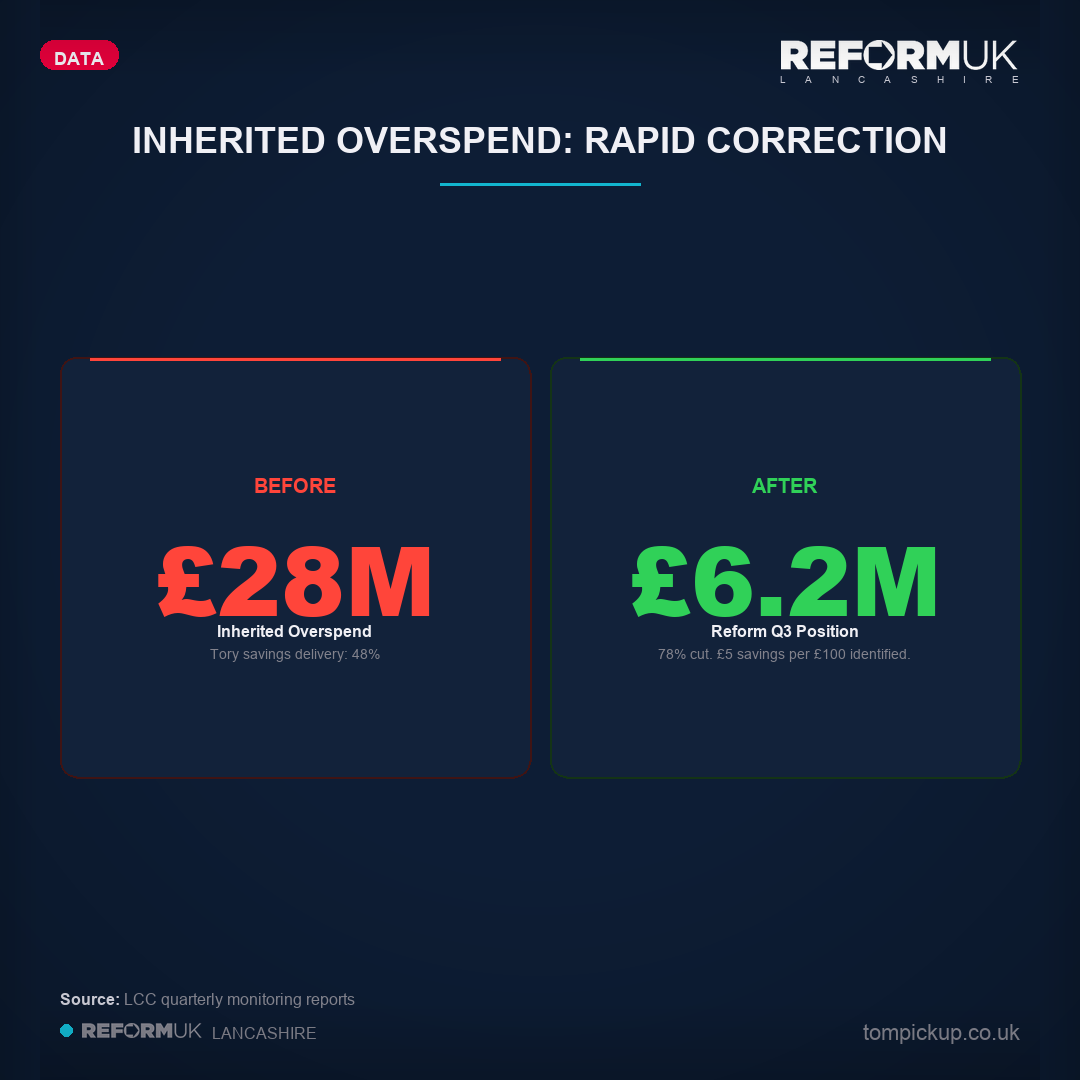
When Reform took control, the council faced a £28 million projected overspend. The Conservatives had set a budget they could not deliver. Their savings programme hit just 48% of targets in 2024/25, meaning more than half the planned savings never materialised.
Nine months later, Reform has reduced that inherited overspend to £6.2 million at Q3. A 78% reduction. Same finance team, same measurement, published on the council website. We have also identified £5 in potential savings for every £100 spent across the council.
Financial Damage: The Full Conservative Record
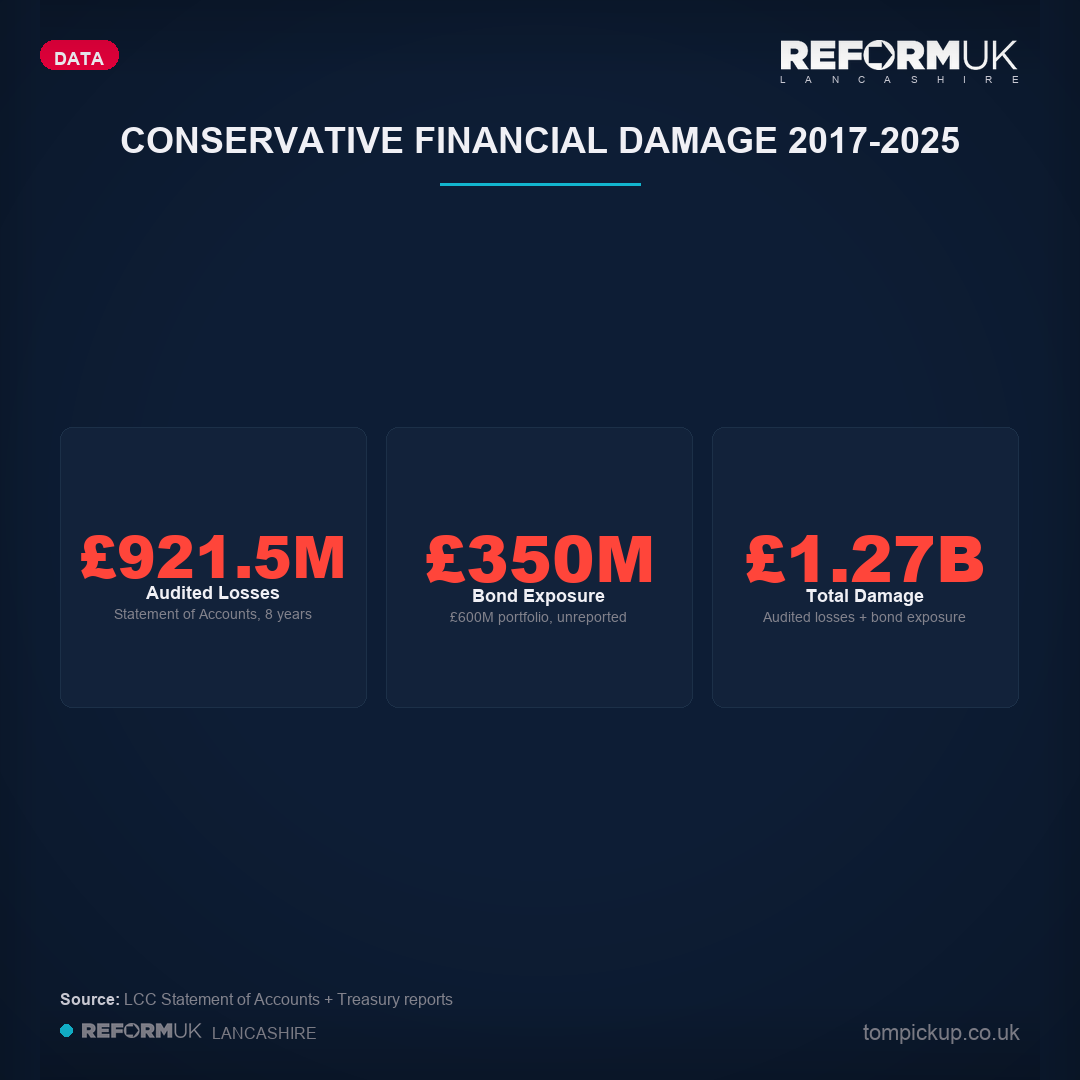
Over eight years, the Conservatives presided over £921.5 million in documented losses. That figure comes from the council’s own audited Statement of Accounts, 2017/18 to 2024/25:
- £416.9M in treasury and financial instrument losses
- £254.5M in disposal and academy transfer losses
- £138.4M in department overspends
- £111.7M in direct subsidy and partnership costs
On top of that, Reform’s scrutiny of the accounts uncovered a £600 million UKMBA bond portfolio with an estimated £350 million unrealised loss. The previous administration never transparently reported these losses to councillors or the public.
Total financial damage: £1.27 billion.
These are not Reform calculations. They are the council’s own audited figures, sourced to specific page numbers in the Statement of Accounts.
Roads: The Backlog They Left Behind
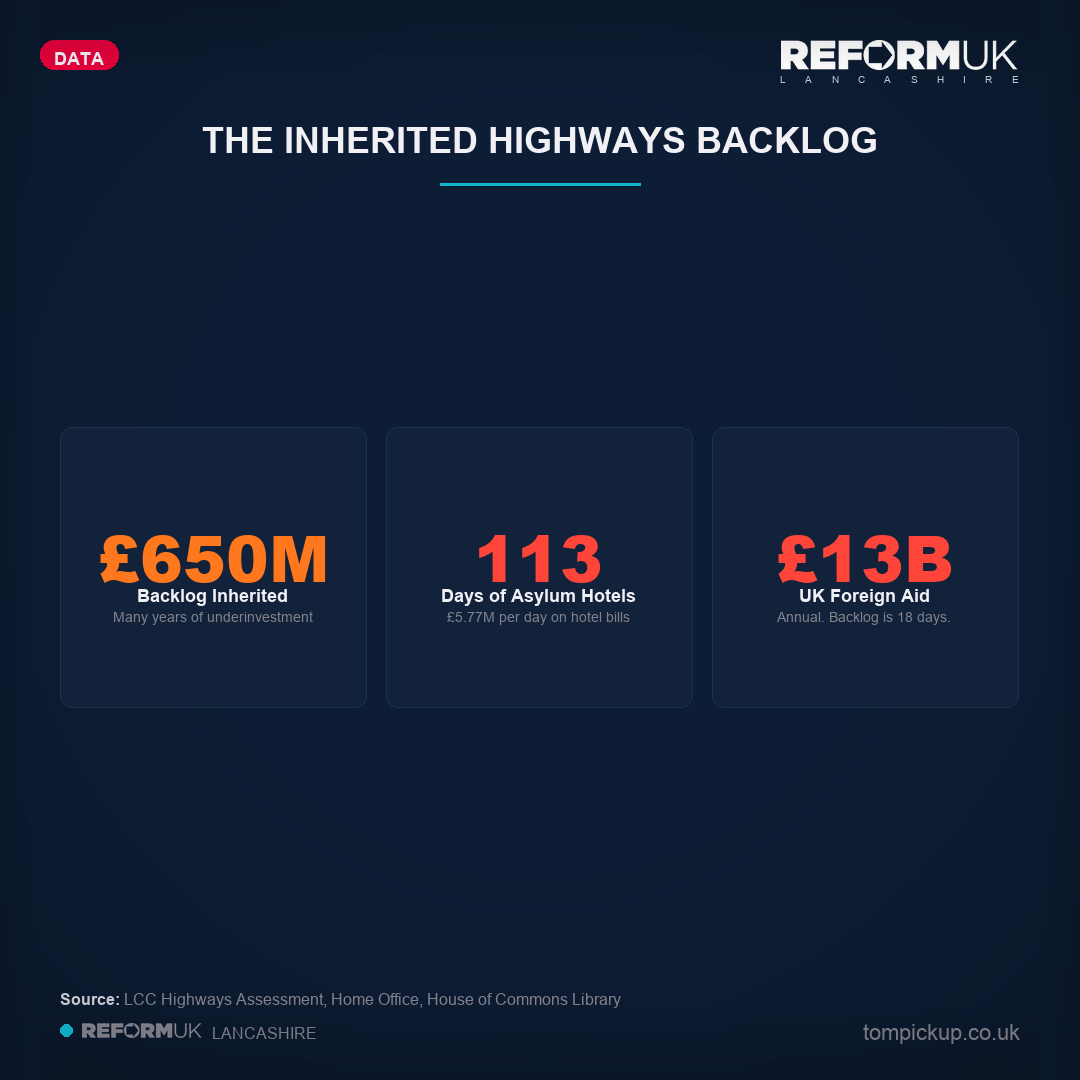
The Conservatives left Lancashire with a £650 million highways maintenance backlog. That figure comes from the council’s own highways condition assessment.
To understand how fixable this is, consider what Westminster chooses to spend elsewhere:
| Comparison | Amount | vs Lancashire Backlog |
|---|---|---|
| UK foreign aid | £13 billion per year | The backlog is 18 days of aid spending |
| Asylum seeker hotels | £5.77 million per day | The backlog equals 113 days of hotel bills |
| Chagos Islands deal | ~£10 billion (real terms, 99 years) | 15 times the entire backlog |
| HS2 spent to date | £40.5 billion | The backlog is 1.6% of what HS2 has consumed |
| National roads backlog | £18.6 billion (ALARM Survey 2026) | Lancashire is 3.5% of the national total |
Sources: House of Commons Library (ODA), Home Office (asylum accommodation), Full Fact (Chagos NPV), Construction Enquirer (HS2), ALARM Survey 2026 (national backlog).
Reform is doing what it can within the budget. A three-year £45 million resurfacing programme targets the 100 worst roads.
Social Care: What Matters Most
Five county care homes faced a £5 million maintenance backlog and an uncertain future. Reform launched an eight-week public consultation. 1,600 residents responded. The message was clear: these homes serve people who have nowhere else to go.
Reform listened. All five care homes remain open, with investment in their future.
That decision goes against the national trend. Across England, local authority care home provision has collapsed, from 64% of beds in 1979 to just 4% today (CMA, 2023). Between 2015 and 2020, 1,578 care homes closed nationally, displacing nearly 50,000 residents. Councils everywhere are shutting their doors. Lancashire kept them open.
In children’s services, Lancashire received a Department for Education improvement notice under the Conservatives. Reform’s response: 677 new SEND school places commissioned, the EHCP backlog programme accelerated, and SEND transport costs reduced by competitive tendering.
Technology: How the Council Works Now
The Conservatives ran Lancashire County Council on paper forms and spreadsheets. Reform invested £4.3 million in the Netcall AI platform, now used by over 1,400 council officers.
The platform handles 72% of initial customer contacts without human intervention. Residents get answers faster. Staff spend their time on cases that actually need human judgement.
AI-equipped sensors on bin lorries scan road surfaces during normal collection rounds, identifying defects before they become complaints. The data feeds directly into the highways maintenance programme.
None of this is expensive or experimental. It is the application of technology that has been standard in the private sector for years but that local government has been slow to adopt.
What Comes Next
Nine months is not enough to undo many years of neglect. The £650 million highways backlog will take a decade. The SEND improvement notice requires sustained investment. The financial instrument losses cannot be recovered.
But the trajectory has changed. We reversed the 4.99% rot with the lowest council tax rise in over a decade. The inherited overspend has been cut by 78%. We have identified £5 in savings for every £100 of council spending. The care homes are open. The technology works.
We are just getting started.
The next article in this series breaks down exactly where your council tax goes.
Every figure in this article is sourced to official Lancashire County Council records.
Budget monitoring reports, Statement of Accounts, highways condition assessments, and council committee papers are all publicly available at lancashire.gov.uk