Lancashire County Council is asking residents what matters most in next year’s budget. The survey is open until 2 December 2026. Before you answer it, here is where the council tax you pay now actually goes, from a home in Burnley.
Most Burnley homes are Band A
Every home sits in a band from A to H. Councils quote Band D as the standard, and every other band is a fixed fraction of it set in law: Band A pays two thirds of Band D, Band H pays double.
In Burnley, Band D is unusual. Six in ten homes are Band A; about one in fourteen is Band D.2 So most bills here look like the Band A row.
| Band | Burnley Council | County council | Police | Fire | Total |
|---|---|---|---|---|---|
| A | £234.29 | £1,201.17 | £194.93 | £63.15 | £1,693.54 |
| B | £273.34 | £1,401.36 | £227.42 | £73.68 | £1,975.80 |
| C | £312.39 | £1,601.56 | £259.91 | £84.20 | £2,258.06 |
| D | £351.44 | £1,801.75 | £292.40 | £94.73 | £2,540.32 |
| E | £429.54 | £2,202.14 | £357.38 | £115.78 | £3,104.84 |
| F | £507.64 | £2,602.53 | £422.36 | £136.83 | £3,669.36 |
| G | £585.73 | £3,002.92 | £487.33 | £157.88 | £4,233.86 |
| H | £702.88 | £3,603.50 | £584.80 | £189.46 | £5,080.64 |
These are the 2026/27 charges outside a parish.1 Eight parish councils add a little more on top:
| Parish | Band A | Band D |
|---|---|---|
| Padiham | £29.37 | £44.06 |
| Dunnockshaw | £20.51 | £30.77 |
| Hapton | £18.54 | £27.81 |
| Worsthorne with Hurstwood | £17.37 | £26.05 |
| Briercliffe | £13.32 | £19.98 |
| Habergham Eaves | £11.01 | £16.52 |
| Cliviger | £6.29 | £9.43 |
| Ightenhill | £4.91 | £7.36 |
Who gets it
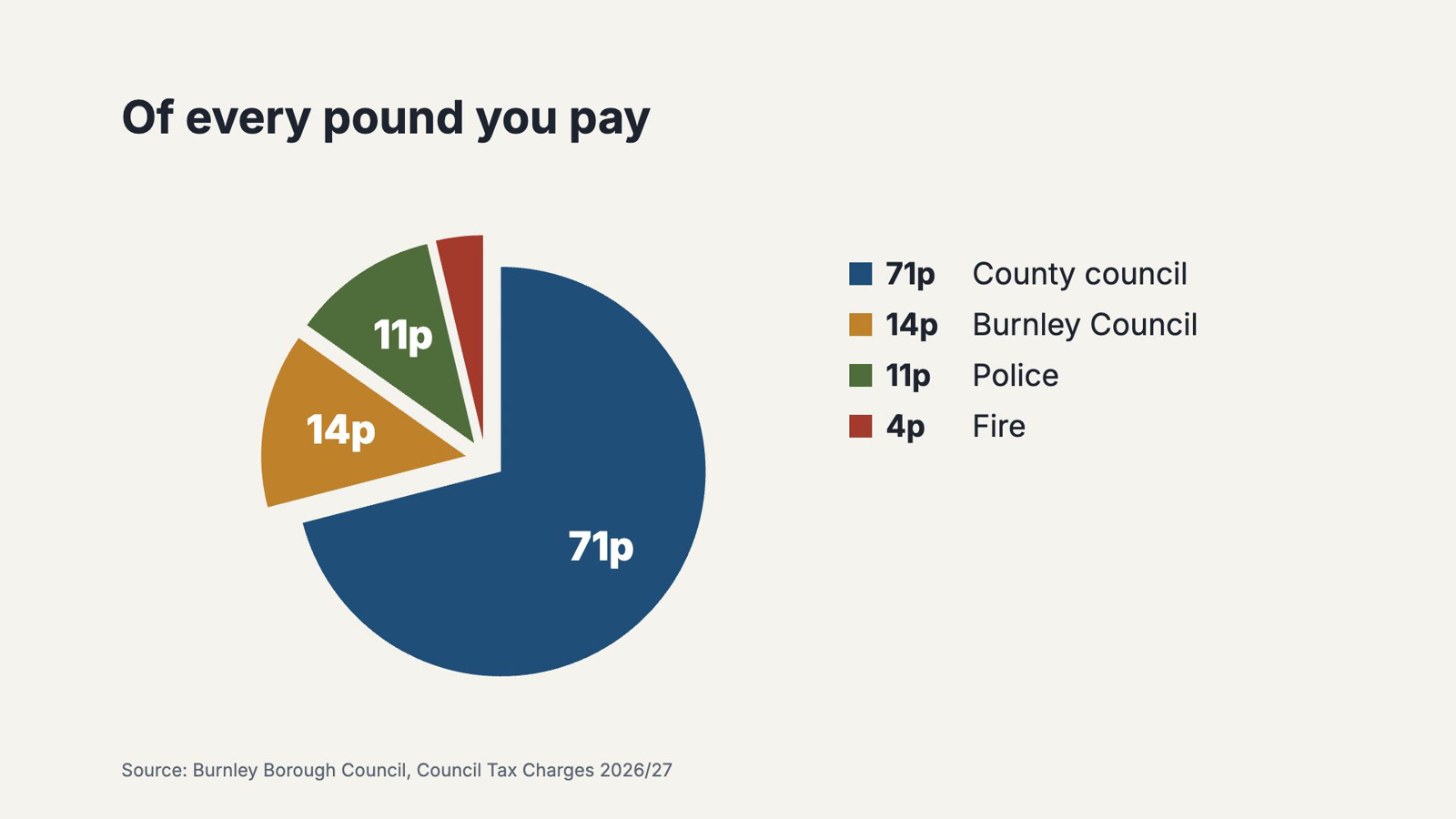
Burnley Council sends every bill and collects all of it, then passes most of it on. Of every pound you pay, the split is the same in every band:
In 2025/26, the latest year published, Burnley had £60.7 million due and collected £57.1 million of it by 31 March 2026: 94.09%. The England rate was 95.6%. Money not in by March keeps being collected afterwards.3
Council tax is only part of each budget
Each body also gets business rates and government grants. Council tax pays for:
- 53.9% of the county council’s £1,329.3 million net budget4
- 38.4% of Burnley Council’s £22.4 million net budget5
- 31.7% of Lancashire Police’s £442.6 million budget, with the police grant paying most of the rest6
- 56.0% of Lancashire Fire’s £80.5 million net budget7
Where the county council share goes
A Band A home pays the county council £1,201.17 a year. Shared out the way the county’s net budget is:4
| Area | From a Band A bill | From a Band D bill |
|---|---|---|
| Adults, health and wellbeing | £504.66 | £756.99 |
| Education and children’s services | £240.11 | £360.17 |
| Roads, transport, waste and environment | £236.65 | £354.98 |
| Corporate budgets, including debt costs | £135.63 | £203.44 |
| IT, finance, legal, HR and the chief executive | £84.12 | £126.17 |
Adult social care
Adult social care is my portfolio as Cabinet Member, and it is the county council’s largest single cost. It takes £512.85 of a Band A bill, about £9.86 a week (£769.27 at Band D).4
Of that, £206.22 at Band A (£309.33 at Band D) is the adult social care precept, which has built up since 2016/17 and must be spent on care.8
At the end of the first quarter of 2026/27, 17,245 people were in long-term care.9 The three largest groups:
| Group | From a Band A bill | People supported | Average cost a week each |
|---|---|---|---|
| Older people and people with physical disabilities | £231.55 | 12,150 | £625 |
| People with learning disabilities and autism | £181.82 | 3,824 | £1,038 |
| People with mental health needs | £41.21 | 1,645 | £751 |
The county council puts it this way:
“Around 55% of the council’s budget is spent on approximately 5% of Lancashire’s population.”10
The challenge for next year
The consultation sets out the scale of it: “Even if council tax increased by the maximum amount currently permitted (4.99%), the council would still need to identify around £79 million of savings and efficiencies to balance next year’s budget.”10
You can try it yourself. The Lancashire Budget Challenge starts with no council tax rise, so the whole gap is on the table, and lets you choose between council tax, spending and reserves.