
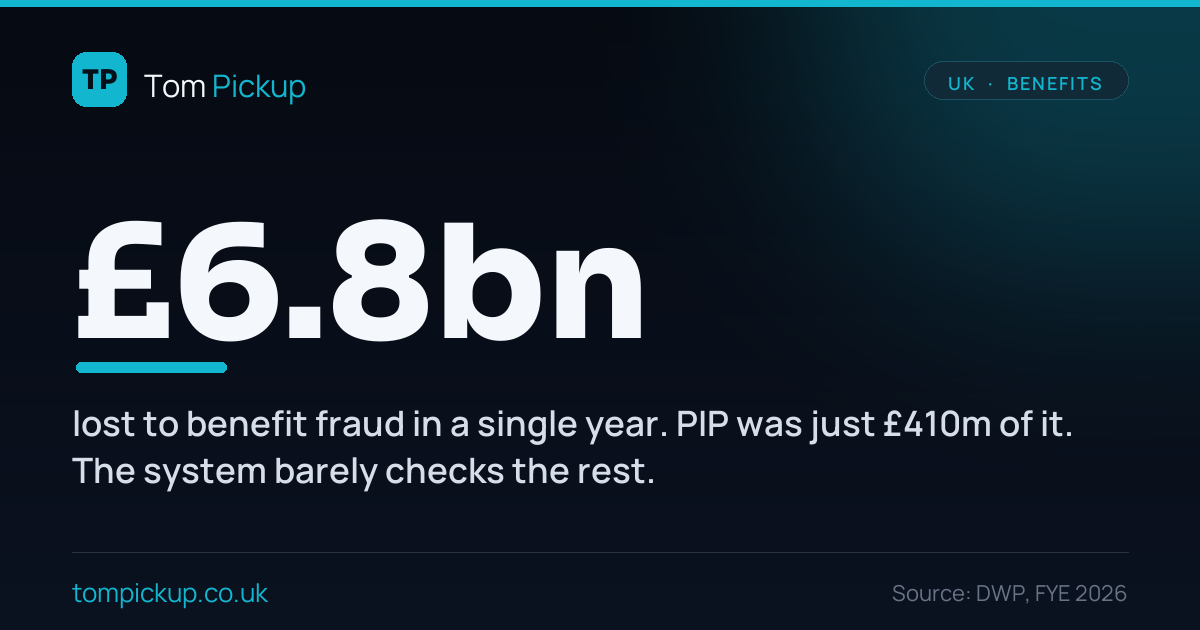
The government published its annual benefit fraud figures last month, and one number jumped out: fraud in PIP, the main disability benefit, has gone from £100 million to £410 million in a single year. Take that seriously. Then look at the rest of the page, because the same figures show £6.8 billion lost to benefit fraud in twelve months, paid out by a state that writes the cheques and then barely checks who is still entitled. That is the real scandal, and it is not mainly in PIP.
The rise is real
For years, fraud in PIP was recorded at close to zero. The new figures, for the year to spring 2026, put it at 1.4%, or £410 million, up from 0.4%, or £100 million, the year before. That is a statistically significant jump, the first real one this benefit has seen.
Almost all of it comes from one thing the government calls “functional needs fraud”, which in plain English means people not reporting that their condition has improved. They were genuinely entitled when they claimed; they are no longer telling the system that things have changed. That is a specific, fixable problem, and it points straight at how rarely awards are reviewed once they are granted.
Now the honest part
If you only read the headline, you would think PIP is where the welfare money leaks. It is not.
Universal Credit fraud ran at 6.8%, some £5.4 billion, nearly five times the PIP rate and thirteen times the cash. The State Pension, the single biggest benefit, had a fraud rate of effectively zero. So the next time a minister talks tough about disabled claimants, remember the government’s own audit says the opposite: PIP is one of the cleaner benefits, the genuine disabled are not the leak, and £5.4 billion is walking out of a different door while Westminster looks the other way.
That matters, and not just for fairness. Get this wrong and you punish hundreds of thousands of genuinely disabled and ill people to chase a problem that is real but small. Burnley alone has more than 10,000 PIP claimants. At a 1.4% fraud rate, the overwhelming majority are exactly who the benefit is for.
Why it still needs fixing
None of that means you wave it through. £410 million is £410 million, and a fraud rate that quadruples in a year is a flashing red light. The cause is clear and so is the cure: a benefit handed out and then barely reviewed will drift out of date. Yet the same week these figures landed, the government had its PIP reforms parked pending a review, the enforcement effort pointed at the wrong target, and the front door left exactly as it was. That is not compassion. It is negligence with your money.
And the bigger prize is obvious from the chart. If you are serious about benefit fraud, the £5.4 billion in Universal Credit is where the money is, not the £410 million in PIP.
What I want done
- Reassess properly. “Functional needs fraud” is people not reporting they got better. The answer is regular, sensible reviews of awards, not a tabloid hunt for cheats.
- Go where the money is. Universal Credit fraud is thirteen times the size of PIP fraud. That is where enforcement should be aimed.
- Defend the genuine majority. A 1.4% fraud rate means 98.6% of PIP is going to people who need it. Any reform has to start from that fact, not bury it.
- Tell the truth about the numbers. A welfare system only keeps public support if it is both compassionate and policed, and if the people running it are straight about where the problems actually are.
Here is the version that holds up. PIP fraud rose, and it should be gripped at the source. But the £6.8 billion bleeding out of the wider system, most of it nowhere near PIP, is what a serious government would chase first. The disabled people of Burnley are not the welfare problem. A Westminster machine that hands out billions and never checks is. The data says so plainly.
Where these numbers come from
You do not need this part to follow the story. It is here so the working can be checked. Everything is from one official source: the DWP’s “Fraud and error in the benefit system, financial year ending 2026” statistics.
- PIP fraud £410m (1.4%), up from £100m (0.4%), with “functional needs fraud” the main driver, rising to 1.2% from 0.3%.
- Universal Credit overpayments 8.5%, of which fraud 6.8% (£5.4bn).
- State Pension fraud rounded to 0.0%.
- Total benefit overpayments 3.2% (£9.9bn); total fraud 2.2% (£6.8bn).
One honest caveat. These are estimates, produced by DWP sampling and review of cases, not a precise count of every pound, and the figures are for Great Britain as a whole, not Burnley specifically. The point is the proportion: PIP is one of the cleaner benefits, the rise is real but small, and the bulk of fraud sits elsewhere.