Burnley is not a town that will not work, and it is not a town full of criminals. But it is a town with serious violence well above the national average, and far too few of the visible, on-the-street officers whose whole job is to stop that violence before it happens. Worse, we are paying more for policing every single year while getting fewer of them. This is what policing a deprived town on the cheap looks like, and it has to change.
The violence is real
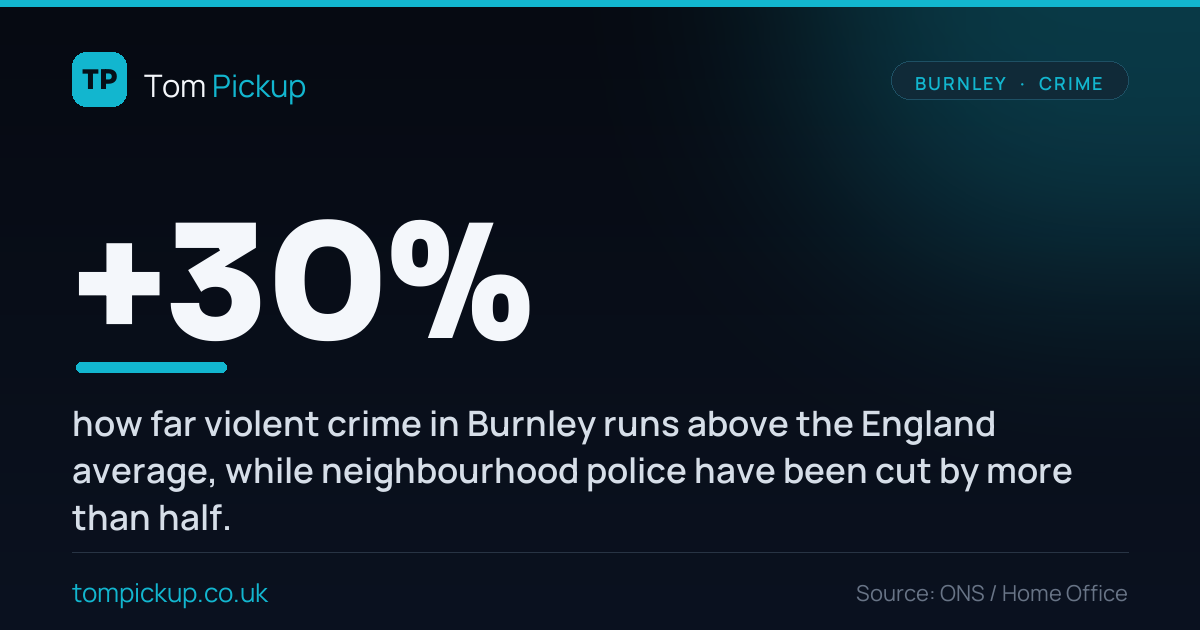
Start with the thing residents already feel. On the official figures, Burnley’s recorded crime runs at 107 offences per 1,000 people, against 89 across England, about a fifth higher. The violence is worse still: 43 violent offences per 1,000 here against 33 nationally, roughly 30% above average, and the borough’s own Community Safety Partnership reports that hospital admissions for violence are the highest in the whole county.
And it is not just numbers. East Lancashire has seen a run of serious knife attacks. In Colne, a man was jailed for stabbing a neighbour in the neck. In nearby Blackburn, a man was sentenced to 24 years for attempted murder after a stabbing in the street. There has been a further serious incident in the area in June 2026 which is now before the courts, and which I will not say a word about while it is live. The courts are doing their part. The question is what we are doing to stop these things happening in the first place.
The scale of the problem with weapons alone is sobering. In a single week last November, Lancashire’s Operation Sceptre took 1,111 knives off the streets of the East Division that covers Burnley, and when officers test-checked twelve shops across Burnley and its neighbours, three sold a knife to an under-age buyer. That is exactly the patient, visible police work that prevents the next stabbing, and it only happens when there are officers to do it.
Policed on the cheap
Here is the part that should make every resident angry. While the violence sits well above average, the police presence that tackles it has been hollowed out.
- The community officers have been gutted. Lancashire’s PCSOs, the neighbourhood officers you actually see on a street or an estate, have fallen from 428 in 2010 to just 186 today, a cut of 57%, and the lowest number on record. They were left out of the recent national drive to recruit more police, so they were never replaced.
- Police officers are only just back to where they were. Lancashire lost around 800 officers in the austerity years, falling from 3,649 in 2010 to 2,850 by 2017. They have since been clawed back to 3,560, but that is still fewer than in 2010, for a county with more demand.
- And you are paying more for it. The policing part of your council tax, the precept, has climbed from £211 to £292 on a Band D home in six years, raised to or near the legal maximum in most of them. Why? Because Westminster cut Lancashire’s central police grant by 28% since 2010 and quietly shifted the bill onto your council tax instead.
So the deal Burnley has been handed is the worst of both worlds: more violence than the national average, fewer visible officers than fifteen years ago, and a police bill that goes up every year. You pay more, and you see less.
Let me be straight with you
I am not going to tell you crime is exploding, because it is not. Overall crime in Burnley has actually fallen a little in recent years, and knife crime nationally fell by 10% in the last year. Pretending otherwise would be the sort of scaremongering I have no time for.
But “falling a bit from a high base” is not safety. Burnley still has violence a third above the average, the highest violence-related hospital admissions in the county, and a thin blue line that gets thinner the moment you look for an officer on foot. The honest case is not that things are getting dramatically worse. It is that they are nowhere near good enough, and that we are deliberately under-resourcing the one thing that helps.
What needs to happen
This is fixable, and it is not even complicated. It needs the will and the money.
- Put neighbourhood officers back on Burnley’s streets. Rebuild Lancashire’s PCSO numbers towards where they were, and give every part of Burnley a named, visible neighbourhood team people actually recognise, not a phone queue and a website.
- Fund it from the grant, not the precept. Reverse the cut to the central police grant so residents stop paying more council tax every year for fewer officers. Policing a deprived town should not depend on how much more you can squeeze out of local taxpayers.
- Back the enforcement that works. Operation Sceptre took over a thousand knives off our streets in a week. Keep that going all year round, with the officers and the school work to match, not as an occasional campaign.
- Make Burnley a priority, not an afterthought. A town with violence 30% above average and deprivation among the worst in England should be near the front of the queue for police resources, not the back.
I am a county councillor, not the Police and Crime Commissioner, so I cannot order another officer onto a Burnley street myself. But I can make the case loudly, with the facts, and I will keep making it: to the Commissioner who sets the budget, to the Government that cut the grant, and alongside anyone of any party who wants the same thing. Burnley has paid more and got less for long enough. Put the police back on our streets.
If you agree, say so. Tell the Lancashire Police and Crime Commissioner, tell your MP, and tell the Government. The more of us who ask, the harder it is to ignore.
Where these numbers come from
You do not need this part to follow the story. It is here so the working can be checked.
- Crime rates (Burnley 107 per 1,000 vs England 89; violence 43.1 vs 33.1; Lancashire 35.3) are from the Office for National Statistics recorded-crime tables, year ending March 2024, released 24 July 2024: Burnley from the Community Safety Partnership tables (Table C5), England and Lancashire from the Police Force Area data tables (Table P3) (the latest editions, to December 2025, show the same gap, with both rates a little lower). Burnley’s own figure is for the borough; comparisons use the ONS series so like is compared with like. I have not used the higher numbers quoted by some crime-map websites, which fold in anti-social behaviour and use a smaller population.
- Falling trend: Burnley’s Community Safety Partnership reports a 6.2% fall in all crime from 2021 to 2024; national knife crime fell about 10% in the year to December 2025 (ONS).
- Hospital admissions for violence “highest in the county” is from the Burnley Community Safety Partnership 2025 Strategic Assessment.
- Police and PCSO numbers are from the Home Office “Police workforce, England and Wales” statistics (officers FTE: 3,649 in 2010, 2,850 in 2017, 3,560 in 2025; PCSOs: 428 in 2010, 186 in 2025).
- The precept (£211 in 2020/21 to £292.40 in 2026/27) and the “28% grant cut since 2010” are from the Lancashire Police and Crime Commissioner’s published budget reports and funding pages.
- Operation Sceptre (1,111 knives in a week; the under-age sales checks) is from Lancashire Constabulary’s official press releases, November and December 2025.
- The Colne and Blackburn cases are concluded and were reported by Lancashire Constabulary. The recent local incident referred to as before the courts is deliberately left unspecified, as commenting on a live case would be wrong.
One honest note. Policing is run by the Police and Crime Commissioner and the Chief Constable, not by Lancashire County Council, so this is an argument I make as a local representative, not a budget I control. The figures are public; the case for acting on them is the point.
Correction, 28 September 2026. An earlier version gave the Lancashire force area’s violent crime rate for the year to March 2024 as 36.5 per 1,000. The ONS figure is 35.3 (Police Force Area data tables, Table P3). The chart has been corrected. The Burnley and England figures were right and are unchanged.