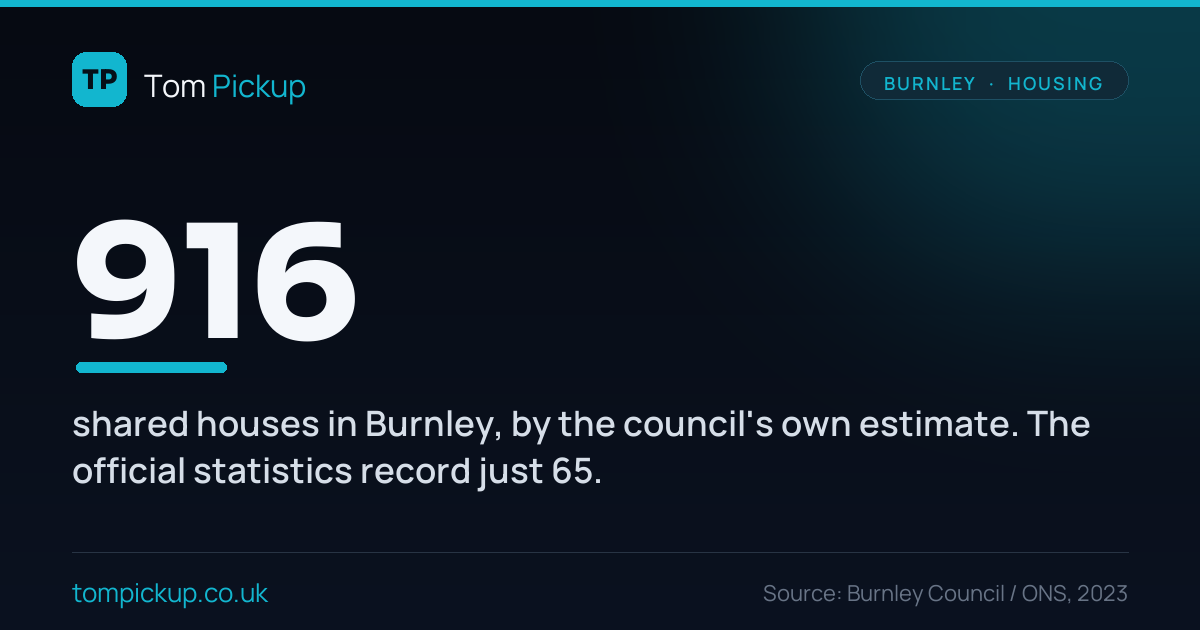
Ask the official statistics how many shared houses there are in Burnley and you get one answer. Ask the council’s own researchers and you get an answer fourteen times bigger. That gap is not a rounding error. It is a measure of how little the people meant to be watching actually know about the bottom of the town’s housing market, where family homes are quietly carved up room by room and, for years, nobody was counting.
Shared houses are not the problem in themselves. For a single adult on a low income, a room in one is often the only thing they can afford. Done properly, they are housing the town needs. Done badly, they mean overcrowding, damp, fire risk and real strain on a street. The trouble is that Burnley cannot manage what it cannot see, and for years it could barely see this at all.
Sixty-five, or nine hundred and sixteen
The 2021 census counted 65 shared houses in Burnley. That is the official number, produced the same way for every council in the country.
The council’s own study, carried out to support its planning decisions, put the real figure at about 916. It got there by combining licensing records, planning applications, council tax data, student records and housing safety inspections, rather than relying on the narrow census definition. That is around one in every 46 homes in the borough.
Both numbers are real. They just measure different things, and the honest conclusion is the uncomfortable one: the figure the government publishes for Burnley is out by a factor of fourteen, and the more thorough local count had to be built almost from scratch.
The worst part is what the study found about the council’s own knowledge. Of the 916, it had records for only about 400. The other 516 were modelled to exist but appeared on no official list. More than half the town’s shared houses were, in effect, invisible.
They are not spread evenly
Shared houses cluster. They are concentrated in a handful of inner wards where the terraces are cheap and the rooms are easy to let. In Bank Hall and Trinity, the two worst-affected wards, the council estimates around one home in fifteen is a shared house.
This is the same cheap terraced stock that the buy-to-let boom has been buying up. A small two-bedroom house bought for rent can be turned, room by room, into a four or five-person let, and for years that conversion could happen without anyone asking the council first.
What the council has started to do
To its credit, Burnley has finally begun to act. Two tools are now in place.
- An Article 4 Direction, in force since October 2024, means a landlord now has to apply for planning permission before turning a family home into a small shared house. It covers 9 of the 15 wards: the inner wards where the problem is worst. Those nine contain roughly 775 of the 916 estimated shared houses, about 85% of them.
- Selective licensing, in force since April 2025, requires landlords to be licensed and to meet basic standards in five designated areas: Trinity, Queensgate, Gannow, Daneshouse with Stoneyholme and Padiham, part of the division I represent.
Both are real progress. But there are two clear gaps.
First, six wards still have no Article 4 protection at all. They hold an estimated 141 shared houses between them today, and they are exactly where the next wave of conversions will go once the inner wards are locked down. Protection that stops at the ward boundary just moves the problem next door.
| Ward with no protection | Estimated shared houses |
|---|---|
| Lanehead | 44 |
| Hapton with Park | 32 |
| Briercliffe | 22 |
| Whittlefield with Ightenhill | 17 |
| Cliviger with Worsthorne | 14 |
| Coal Clough with Deerplay | 12 |
Second, the 516 missing houses are still missing. Article 4 stops new conversions. It does nothing about the ones that already slipped through unrecorded, and a house nobody knows about is a house nobody inspects.
What I want done
- Extend the protection to all 15 wards. There is no good reason six wards are left exposed to the conversions the other nine are now shielded from. My colleague Cllr Liam Thomson has been pressing the same case.
- Find the missing 516. Cross-checking the council’s own data, council tax records and the new licensing register should bring most of them into view. A shared house the council can see is one it can hold to a standard.
- Use the licensing powers properly. Licensing is only worth having if the standards are inspected and enforced, not just charged for.
The people who live in these houses are usually the people with the fewest choices: single adults on low incomes, often on benefits, taking the only room they can afford. They are precisely the residents who most need someone checking the wiring and the fire doors. The first step is admitting how many of these homes there really are. The council’s own researchers already did the hard part. The only question left is whether anyone in charge has the will to act on it.
Where these numbers come from
You do not need this part to follow the story. It is here so the working can be checked.
All of this is for the Borough of Burnley (local authority E07000117), the council area, not the parliamentary constituency.
- The official count of 65 is from ONS Census 2021 (table RM192, dwellings that are houses in multiple occupation, by local authority). It uses a narrow statistical definition and is known to undercount, which is the point.
- The estimate of 916, the 400 known and 516 modelled figures, the share of housing stock and the ward-by-ward numbers all come from Burnley Borough Council’s HMO modelling, prepared in 2023 for its Article 4 decision (the HMO Article 4 Background Document, October 2023, Tables 4 and 5). The council’s ward-by-ward estimates sum to the 916 total.
- The Article 4 and selective licensing details are from Burnley Borough Council’s own published policy: Article 4 in force October 2024 across nine wards, selective licensing in force April 2025 across five.
Two honest caveats. The 916 is a careful estimate, not an exact count, because nobody knows the true number, which is exactly why the work was needed. And the per-ward figures are modelled, so treat them as a reliable picture of where the concentration lies rather than a house-by-house census.